
Haaland has taken the headlines, but Norway’s run to the last 16 has been built on far more than one superstar. Norway arrived at the 2026 World Cup with excitement, expectation and one obvious question: could a team led by Erling Haaland and Martin Ødegaard finally turn promise into a tournament run?
So far, the answer has been emphatic. Back at the World Cup for the first time in a generation, Norway have not played like tourists, outsiders or a side simply grateful to be here. They have attacked with conviction, absorbed setbacks, survived the brutality of the group stage and then carried their momentum into the knockouts with a 2-1 victory over Ivory Coast.
Now Brazil await in the last 16, and suddenly Norway’s tournament is no longer just a feel-good return story. It is a genuine test of how far Ståle Solbakken’s side can go.
The headline figure is unavoidable. Haaland has scored five goals already, leading Norway’s charge and giving every opponent the same impossible dilemma: defend deep and invite pressure, or step up and leave space for one of world football’s most ruthless finishers.
But Norway’s campaign has not been a one-man show. Ødegaard has supplied three assists, Patrick Berg has added two more, and the balance between direct power and midfield control has given Norway a clearer identity than many expected. This is not just Haaland dragging his country through a World Cup. It is Norway discovering they belong.
A blistering start set the tone
Norway’s tournament began with the kind of performance that instantly changed the mood around the squad. The 4-1 win over Iraq was not merely an opening victory; it was a statement that Norway had arrived with attacking intent rather than caution. Haaland was immediately central, but the most encouraging aspect was the variety of Norway’s threat. They pressed with purpose, moved the ball forward quickly and looked comfortable turning possession into territory.
That mattered because this Norway team has sometimes been accused of relying too heavily on moments from its two biggest names. Against Iraq, the structure around them worked. Ødegaard found spaces between the lines, Berg helped move the ball through midfield, and Norway repeatedly attacked before Iraq could settle.
The second match against Senegal brought a different kind of test. Where the opener had been about authority, the 3-2 win over Senegal was about nerve. Norway had to live with pressure, absorb spells without control and still find the attacking clarity to come through a chaotic contest. In many ways, that victory told us more about Solbakken’s side than the first one did.
World Cup teams rarely progress smoothly. They must suffer, adapt and keep their heads when matches become emotionally unstable. Norway did that against Senegal, and the win secured qualification with a game to spare. It also allowed Solbakken to make a calculated decision against France.
The France defeat needs context
The 4-1 defeat to France looked heavy on paper, but it should not define Norway’s group stage. With qualification already secured, Solbakken rotated heavily and protected key players for the knockout rounds. Against one of the tournament favourites, that weakened Norway side was punished. The result dented the record but not the wider trajectory. In fact, the reaction since then has been more important than the defeat itself.
Teams can lose rhythm after a dead-rubber rotation. Norway did not. They returned to their strongest shape against Ivory Coast and once again found a way to win a match that could easily have slipped away.
That 2-1 victory in the round of 32 was another sign of competitive maturity. Ivory Coast had the athleticism and individual quality to make the game uncomfortable, but Norway stayed direct, stayed dangerous and trusted their defining weapon. When Haaland is in this form, that trust is rarely misplaced.
Read more from Oddsfactory: 4 In 10 Norwegian Bettors Back Norway To Shock Brazil
Haaland scores, Ødegaard conducts
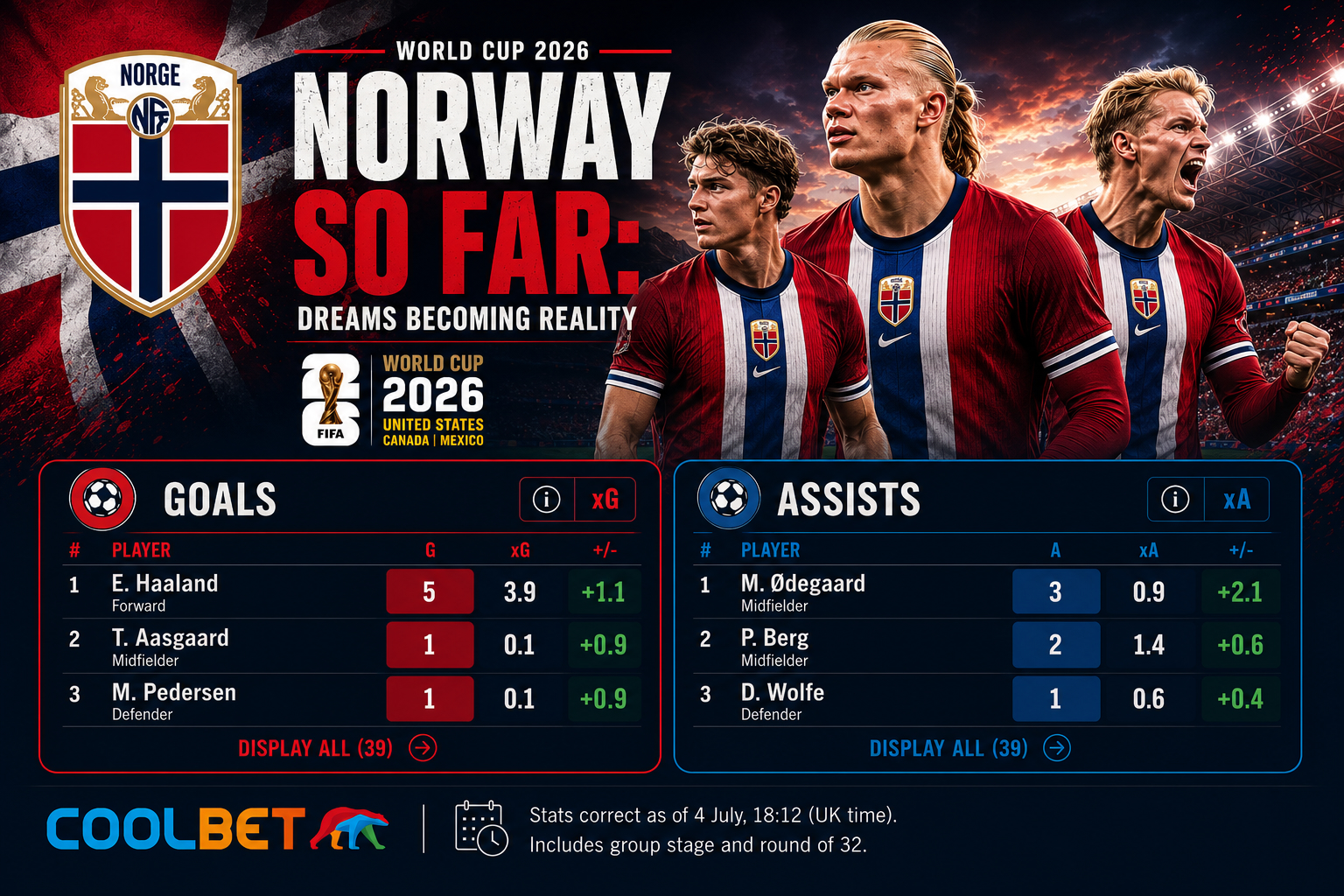
The numbers tell the story of Norway’s tournament hierarchy. Haaland leads the goals chart with five goals from 3.9 xG, outperforming expectation but not in a way that looks unsustainable. He is getting chances, occupying defenders and finishing at the rate elite strikers are expected to finish.
Behind him, Thelo Aasgaard and Marcus Pedersen have also contributed goals, underlining that Norway are not entirely dependent on one source of finishing. The creative numbers are just as important.
Ødegaard has three assists from 0.9 xA, while Berg has two from 1.4 xA. David Møller Wolfe has also contributed an assist from defence. That split matters because it shows Norway’s supply line is not limited to one pattern.
Ødegaard gives Norway imagination. Berg gives them progression and tempo. Wolfe’s contribution from deeper areas reflects how aggressively Norway can attack through their wide players and full-backs.
Together, they have made Haaland’s tournament possible. The Manchester City striker is the final act, but Norway’s attacking machine is being powered by more than just his movement and finishing. That is why Brazil should treat this as a serious tactical problem, not simply a star-versus-star storyline.
Read more from Oddsfactory: Brazil vs Norway
Brazil will test Norway’s ceiling
The meeting with Brazil now gives Norway the perfect stage. There is history here, of course. Norway have never lost to Brazil, and the 2-1 victory at the 1998 World Cup remains one of the most famous results in Norwegian football history. But nostalgia will only carry a team so far.
This Norway side must deal with Vinícius Júnior, Matheus Cunha, Brazil’s speed in transition and the tactical intelligence of Carlo Ancelotti. They will not be able to attack recklessly for 90 minutes and expect to survive.
But Brazil have shown vulnerabilities. They needed a late comeback to beat Japan in the round of 32, and their tournament has raised questions about balance, rhythm and defensive protection. That gives Norway hope.
Solbakken’s team are unlikely to dominate the ball, but they do not need to. Their route to victory is clear: stay compact, move quickly through Ødegaard and Berg, and get Haaland running at Brazil’s back line whenever the opportunity appears. It is a simple plan in theory and a brutal one to defend when executed properly.
Norway are no longer just happy to be here
Whatever happens against Brazil, Norway’s World Cup has already achieved something significant. They have reintroduced themselves to the global stage with personality, goals and belief. They have given their supporters a tournament to remember. They have shown that the Haaland-Ødegaard generation can carry national-team football beyond qualifying campaigns and into knockout drama.
But the feeling around this team has changed. After beating Iraq, Senegal and Ivory Coast, Norway are no longer simply measuring progress by participation. They are close enough now to see a quarter-final place, and good enough to believe it is possible. Brazil remain the bigger football nation, the heavier name and the more decorated side. Norway, though, have momentum, clarity and the most feared striker left in the tournament. For the first time in decades, the dream does not feel distant. It feels alive.