
The five-time champions have reached the last 16, yet their World Cup campaign has raised as many questions as answers Brazil arrived at the 2026 World Cup carrying the familiar burden of expectation, but also something different: uncertainty.
Carlo Ancelotti’s appointment gave the Selecao a coach of enormous stature, yet the tournament has not become the smooth statement of authority many expected. Brazil have shown flashes of individual brilliance, found new attacking solutions and still topped Group C, but they have also looked vulnerable, reactive and strangely dependent on late moments.
That contradiction defines their campaign so far. Brazil opened with a 1-1 draw against Morocco at MetLife Stadium, a result that immediately punctured the sense that Ancelotti’s side would simply cruise through the section. Ismael Saibari put Morocco ahead before Vinícius Júnior rescued a point with a superb equaliser, while Alisson’s late saves ensured Brazil avoided an even more damaging start.
The response against Haiti was more convincing. Matheus Cunha scored twice in a 3-0 win, with Vinícius also on target, giving Brazil their first victory of the tournament and temporarily easing the pressure. That result mattered not only because of the scoreline, but because Cunha’s sharpness gave Ancelotti a genuine centre-forward solution in a team that has sometimes lacked penalty-box authority.
Their best group performance came against Scotland. Brazil won 3-0, Vinícius scored twice, Cunha added another and teenage forward Rayan impressed with his energy and pressing after replacing the injured Raphinha in the starting XI. It was the closest Brazil have come to looking like a fully functioning Ancelotti team: compact enough without the ball, quick in transition and ruthless when Scotland made mistakes. Yet the round-of-32 tie against Japan brought the doubts rushing back.
Brazil were poor for long spells in Houston and fell behind to Kaishu Sano’s first-half goal. Japan’s defensive structure frustrated them, forcing Ancelotti into a bold second-half reshuffle. The Italian introduced Endrick and pushed Brazil into a more aggressive 4-2-4, a move that changed the match but also underlined how close the Selecao had come to trouble.
Casemiro headed Brazil level before Gabriel Martinelli struck deep into stoppage time to complete the comeback and send Brazil into the last 16. It was dramatic, emotional and valuable. It was not especially reassuring.
Vinícius leads, Cunha emerges, but Brazil’s balance remains fragile
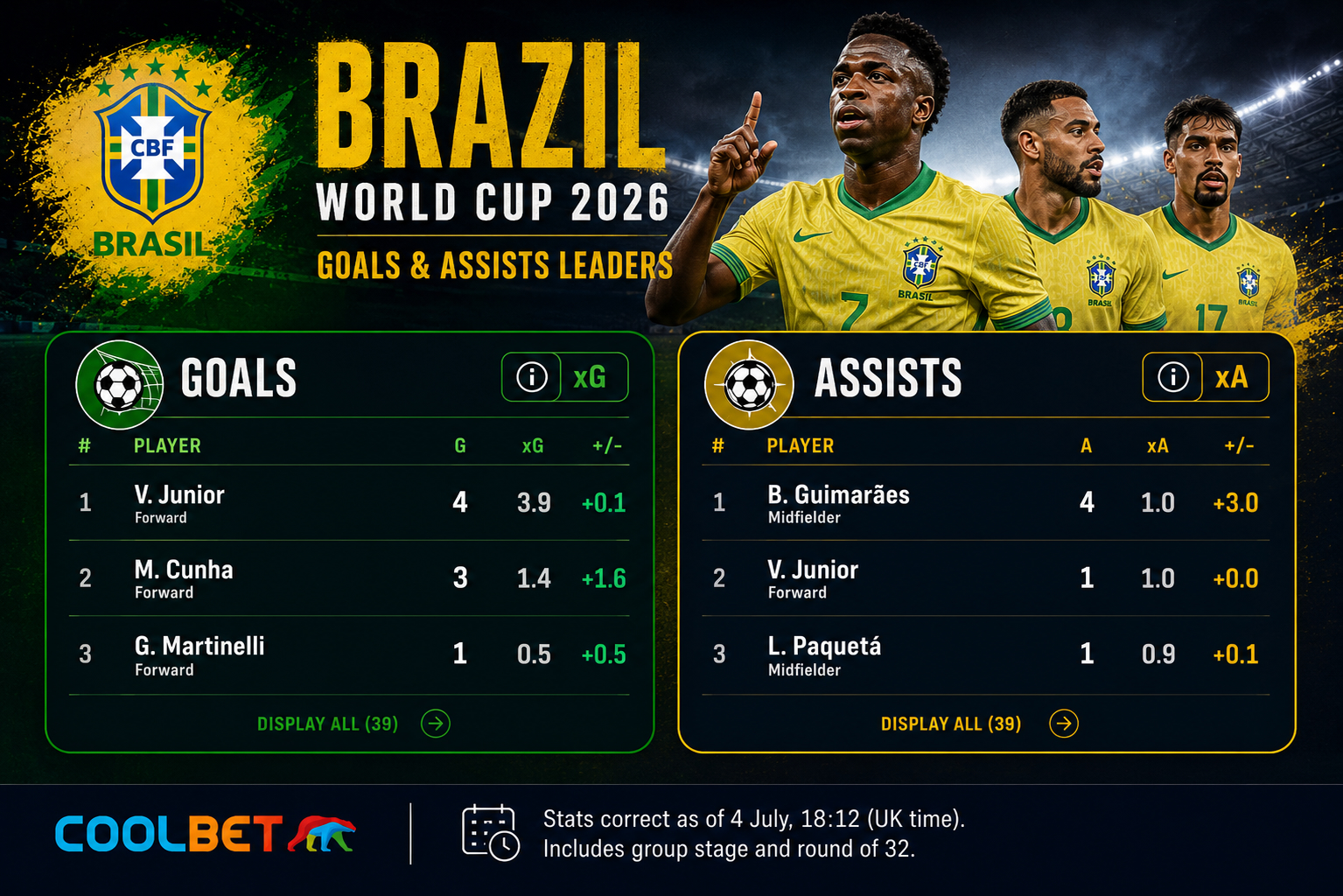
The biggest positive has been Vinícius Júnior. After years of debate about whether his Real Madrid form could fully translate to the national team, Vinícius has been Brazil’s clearest attacking reference in North America. He has scored against Morocco and Scotland, added more direct involvement across the campaign and repeatedly looked like the player most capable of breaking a game open.
Read more from Oddsfactory: 4 In 10 Norwegian Bettors Back Norway To Shock Brazil
Cunha has also been vital. His double against Haiti and goal against Scotland have made him one of Brazil’s most important tournament figures, while his movement has allowed Vinícius to attack space rather than carry the entire forward line alone.
Behind them, Bruno Guimarães has grown in influence as a creator from midfield, while Rayan’s emergence has given Ancelotti a genuinely awkward selection decision now that Raphinha has returned to training.
That is where Brazil’s campaign becomes more complicated. Raphinha’s recovery gives Ancelotti experience and established quality, but Rayan has helped the side press better and move faster. Neymar is also back in the picture, while Martinelli’s winner against Japan strengthens his own case for more minutes. Brazil suddenly have options everywhere in attack, but not yet a settled formula.
The midfield picture is more concerning. Lucas Paquetá is expected to miss the Norway clash with a hamstring injury and may not return unless Brazil go very deep into the tournament. Casemiro also gave Brazil a scare against Japan, although there is more optimism around his availability.
That matters because Brazil’s defensive protection has not always looked secure. Morocco found ways to unsettle them, Japan exposed their lack of rhythm and Norway will offer an entirely different kind of threat through Erling Haaland, Martin Ødegaard and direct attacking transitions.
Norway now represent a dangerous test of Brazil’s nerve
Brazil’s last-16 meeting with Norway is not just another knockout tie. It is a fixture loaded with awkward history. The Selecao have never beaten Norway in four previous meetings, with the most famous coming at the 1998 World Cup, when the Vikings came from behind to win 2-1 in Marseille. Norway now arrive with Haaland in form, Ødegaard pulling strings and the confidence of a side that has already beaten Ivory Coast in the knockout stage.
Read more from Oddsfactory: Brazil vs Norway
For Brazil, this is where the tournament starts to demand clarity. Ancelotti has guided them through turbulence, but Brazil have not yet delivered the kind of complete performance that turns contenders into obvious champions. They have survived. They have adapted. They have found goals when they needed them.
Now they must prove they can control a dangerous opponent from the start, rather than rely on another rescue act. Brazil are still standing, and with Vinícius flying and Ancelotti on the bench, they remain one of the most dangerous teams left in the World Cup. But they are not yet convincing. Against Norway, that may finally have to change.