
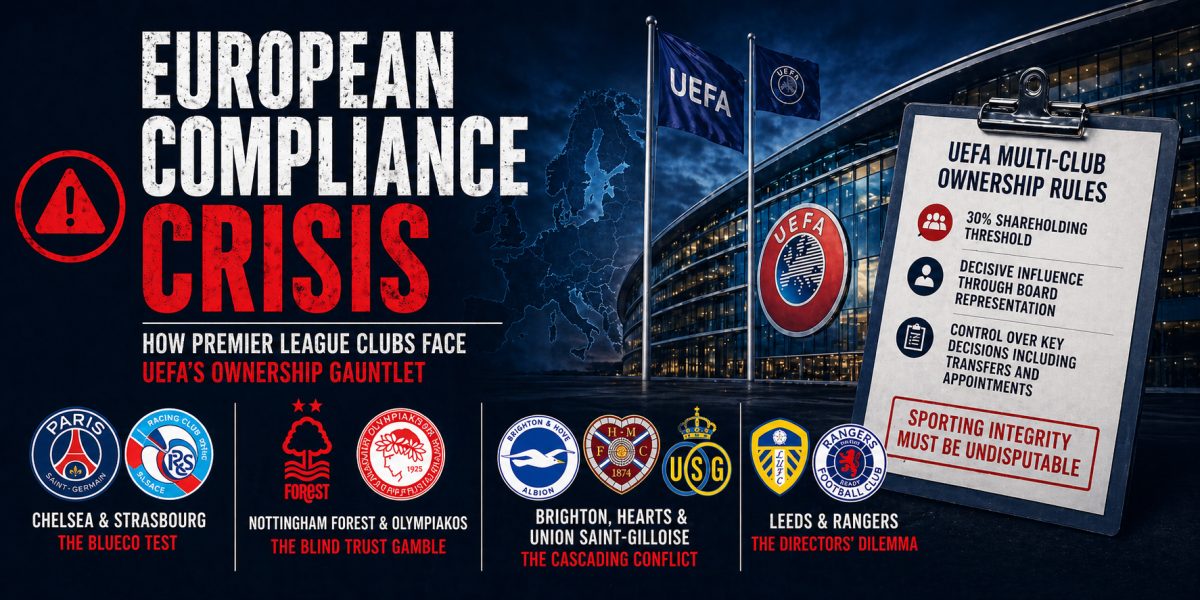
Uefa’s multi-club ownership regulations have emerged as a shadow threat looming over English football’s continental ambitions. With half the Premier League now entangled in complex ownership arrangements, the question is no longer whether clubs will face scrutiny—but whether their compliance efforts will withstand it.
The governing body’s stance is unequivocal. Sporting integrity must be “undisputable”, meaning clubs with overlapping ownership cannot compete in the same competition. The trigger points are well-documented: 30% shareholding thresholds, decisive influence through board representation, and control over key decisions including transfers and appointments. Yet interpretation of these rules has proven contentious, with precedent suggesting Uefa’s enforcement is increasingly rigorous.
Last season’s casualties illustrated the stakes. Crystal Palace, Drogheda United and FC DAC 1904 all fell foul of the regulations, with their subsequent appeals to the Court of Arbitration for Sport dismissed. In December, Uefa reiterated that the 1 March compliance deadline remained “strict”, prompting frantic activity across multiple Premier League boardrooms in late February.
Chelsea and Strasbourg: The BlueCo Test
To many observers, Chelsea and Strasbourg represent the most transparent example of multi-club operation under a single umbrella. Both operate under BlueCo, and should they qualify for the same competition, Uefa’s enforcement record will face its most significant test.
The connection is undeniable. Manager Liam Rosenior transferred from Strasbourg to Stamford Bridge in December, whilst 11 players have moved between the clubs this season. Yet BlueCo has attempted remedial action. On 17 February, four board members of BlueCo Alsace—Chelsea’s joint-sporting directors Paul Winstanley and Laurence Stewart, plus directors James Pade and Jeffrey Wilbur—stepped down. Co-owners Todd Boehly and Behdad Eghbali resigned as BlueCo Data Limited directors on 28 February, though both remain on Chelsea’s board.
Whether these measures satisfy Uefa remains unclear. Precedent suggests that if both clubs enter the same competition, they would face a transfer embargo until January 2028. Chelsea’s Champions League hopes have evaporated due to recent form, leaving them potentially outside European qualification via the league. However, their FA Cup final appearance offers an alternative pathway to Europa League football. Strasbourg sit eighth in Ligue 1 with modest domestic qualification chances, but a Conference League triumph would secure Europa League entry. Uefa’s regulations contain no specific clause addressing European titleholders, creating potential ambiguity should both clubs secure continental football through different routes.
 Advertisement
Nottingham Forest and Olympiakos: The Blind Trust Gamble
Last year, Nottingham Forest owner Evangelos Marinakis placed the club into a blind trust ahead of potential Champions League qualification, preempting conflict with his other club, Olympiakos. Now, with Forest in the Europa League semi-finals and Olympiakos threatening Champions League qualification, the arrangement faces its ultimate test.
Under a blind trust structure, relevant parties transfer shares to independent trustees who assume sole decision-making authority. On 28 February, Marinakis relinquished control to Pittville Four Limited, managed by Janet Lucy Gibson, Henry Peter Hickman and Eleanor Catherine Walsh. These trustees were simultaneously added to Forest’s board, replacing previous directors.
A critical timing issue has emerged. The new trustees had to pass the Premier League’s owners and directors test, a process not completed until 17 April at Companies House. Yet the Premier League’s register, last updated 2 April, still lists Marinakis and the replaced directors. Uncertainty persists over whether Uefa will recognise the 28 February relinquishment date or demand 17 April compliance certification.
Forest maintain that control was officially transferred on 28 February and anticipate no Uefa issue. Precedent offers partial reassurance: two years ago, the Club Financial Control Body accepted blind trusts to permit Manchester City and Girona into the Champions League, alongside Manchester United and Nice in the Europa League. However, the CFCB explicitly stated it “will not be bound by this alternative in subsequent seasons”—meaning no absolute certainty exists for future applications.
AdvertisementBrighton, Hearts and Union Saint-Gilloise: The Cascading Conflict
Tony Bloom’s football portfolio has expanded considerably beyond Brighton’s success. The owner now holds interests in Scottish Premiership leaders Hearts and Belgian club Union Saint-Gilloise, creating potential qualification conflicts across multiple European competitions.
Should Hearts or Union Saint-Gilloise reach Champions League qualifying, they could threaten Brighton’s European place entirely. Under MCO rules, teams in higher-ranked competitions receive priority; if either Scottish or Belgian club lost in Champions League qualifying and dropped into Brighton’s competition level, Uefa would prohibit simultaneous participation—potentially excluding the Seagulls entirely.
Bloom demonstrated awareness of this hazard. After reducing his Union Saint-Gilloise stake below 30% ahead of the 2023-24 Europa League season, he subsequently purchased Hearts with precision, limiting his shareholding to exactly 29%. Whether this pre-emptive structuring satisfies Uefa’s broader “decisive influence” assessment remains untested.
Leeds and Rangers: The Directors’ Dilemma
Leeds’ European hopes ended with Sunday’s FA Cup semi-final loss to Chelsea, but the club had already addressed potential multi-club conflicts. Leeds operate under 100% 49ers Enterprises ownership, whilst the same consortium holds 51% of Rangers.
Paraag Marathe, on Leeds’ board and exercising 49ers voting rights, simultaneously served as Rangers vice-chairman—creating the core conflict. On 27 February, Marathe stepped down from Ibrox, as did Gene Schneur, who held board positions at both clubs. Leeds assert these departures would have resolved any MCO breach, though the moot point remains untested given their FA Cup elimination.