


| 1X2 | Home | Draw | Away | |
|---|---|---|---|---|
|
Coolbet
|
10.00 | 5.20 | 1.32 | Go to Coolbet → |
|
ComeOn
|
9.70 | 4.90 | 1.31 | Go to ComeOn → |
|
Unibet
|
12.50 | 5.60 | 1.30 | Go to Unibet → |
|
Norsk Tipping
|
9.00 | 4.80 | 1.28 | Go to Norsk Tipping → |
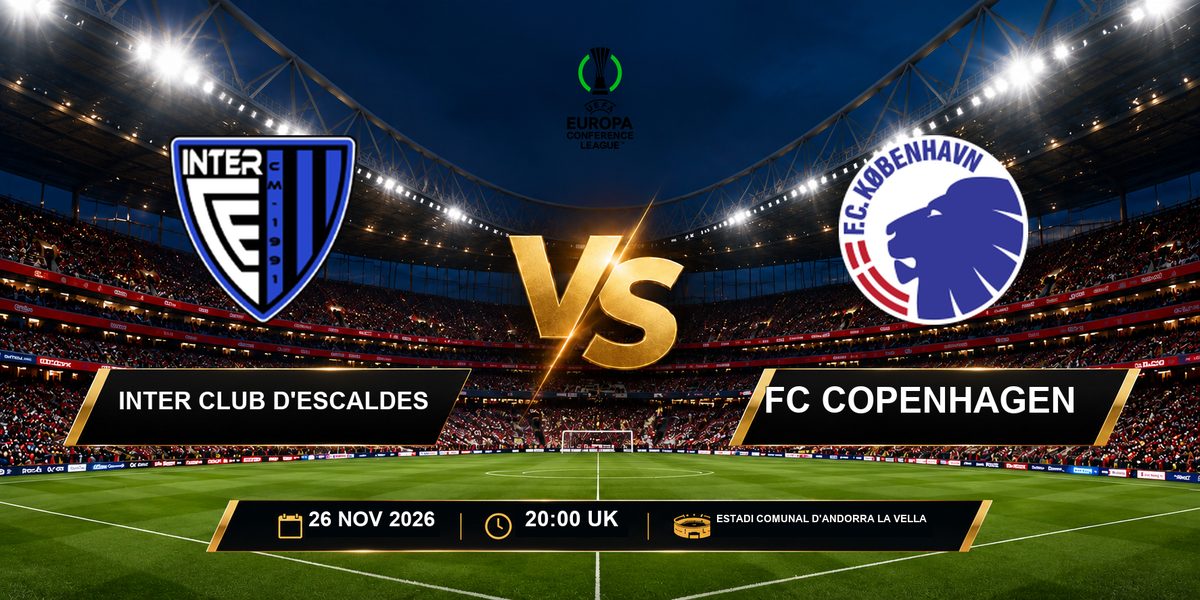
Felip Ortiz’s announced departure from Inter Club d’Escaldes frames Thursday’s Europa Conference League group fixture against FC Copenhagen as a farewell for the Andorran coach, and the local narrative promises an emotional occasion at Estadi Comunal d'Andorra la Vella. Copenhagen arrive after a stinging 5–0 Superliga defeat, a red card for Ákos Markgráf and an active appeal process that complicates selection plans for head coach Bo Svensson. Kick-off is 20:00 GMT on 26 November, leaving Copenhagen with a tight turnaround before a major domestic fixture on Sunday. The match carries contrasting headlines: a club celebrating a historic group-stage presence versus a big Danish side juggling disciplinary business and fixture congestion.
Inter Club d'Escaldes
Cadena SER’s reporting that Ortiz will leave for FC Botoșani after this match has been treated as definitive locally and the coach himself has asked for the spotlight to remain on his players, which shapes the pre-match mood. The club and local media frame Thursday as Ortiz’s last game after two years that included domestic titles and Inter’s historic group-stage qualification; that public closure is likely to concentrate supporters and the squad on delivering a memorable performance for him. The club’s official channels also confirm the match details, and local reporting indicates assistant Gerard Garcés is expected to step in as interim after Ortiz departs — a continuity signal that may limit immediate upheaval in training routines.
Those personnel developments alter the match-level picture in practical ways. Ortiz’s farewell can be galvanising: players who have shared recent success under him may be energised to produce a strong home display, particularly in front of what will be framed as a landmark crowd. At the same time, the certainty of an imminent leadership change cuts both ways; while Garcés’ likely interim role suggests stability, the knowledge this is a final appearance for the head coach could reduce tactical tinkering and encourage a simpler, risk-managed approach designed to secure a proud result. Inter’s recent European outings and domestic schedule show a side accustomed to high-intensity moments in a league of limited depth, so managing emotional peaks and defensive organisation will be an essential coaching task on Thursday.
As an opponent, FC Copenhagen represent a different calibre and set of expectations to the teams Inter typically face. Inter’s group-stage status is historic for Andorran football and has infused this tie with local significance, but Copenhagen bring a deeper squad, continental experience and professional resources that usually determine outcomes in matches of this kind. Inter must therefore convert the farewell atmosphere into effective match situations — set-piece threats, disciplined defensive phases and opportunistic forward play — if they are to bridge the quality gap. The match also provides Inter with an opportunity to underline the club’s progress on a European stage before a managerial transition, which gives the players a clear, immediate incentive beyond any sentimental narrative.
 Advertisement
FC Copenhagen
Copenhagen’s 5–0 reverse at FC Nordsjælland on 22 November — recorded in the club’s official match report and highlighted by the red card to Ákos Markgráf — has placed Svensson under short-term pressure and put disciplinary business centre-stage. The club has formally paid to appeal the red card and the yellow that edges Mads Emil Madsen toward suspension; the outcome of those appeals will materially affect who is available for the upcoming Superliga meeting with Midtjylland and will therefore shape how Copenhagen’s staff rotate for the trip to Andorra. Danish media coverage has amplified frustration with refereeing and the disciplinary process, creating an external narrative that the coaching staff must manage ahead of a European away fixture.
Those circumstances intersect with Copenhagen’s schedule: official club communications show a closed training session on 25 November and a congested sequence of matches (Conference trip, then Midtjylland at home on Sunday and a cup tie soon after). That calendar footprint signals a likely need for rotation and load management. Svensson must weigh the risk of travelling a full-strength squad to an away fixture with limited recovery time against preserving key personnel for domestic priorities. The appeal process complicates that calculus; if the red card is overturned in time, it may free up defensive options and allow a more settled selection, whereas an upheld sanction will force personnel adjustments.
Facing an emotionally charged Inter side with an outgoing coach presents a particular test. Copenhagen’s experienced players have to guard against underestimating the occasion and the local momentum behind Ortiz’s farewell, while the coaching staff must deploy squad members who can respond to a hostile environment and a different pitch profile. The deeper resource pool and recent European results suggest Copenhagen should remain favourites to control large spells of the game, but the combination of disciplinary uncertainty and fixture congestion makes this match more of a selection puzzle than a straightforward away routine.
Verdict
Ortiz’s announced exit makes this fixture unusually loaded for Inter: the club, coaches and supporters have publicly framed it as a last chance to salute a manager who delivered historic progress, and that singular motivation makes the hosts a tougher proposition than their group position alone would suggest. Copenhagen still travel as the more accomplished side with the superior squad and continental experience, but the 5–0 domestic defeat, the red-card appeal and a congested calendar mean Bo Svensson is likely to juggle personnel and may not risk his key starters for every minute in Andorra. On balance, Copenhagen’s quality should prevail if they impose structure early and protect their defensive choices, but Inter’s emotional platform and home setting increase the danger of an upset or a narrow scoreline. Our prediction: FC Copenhagen to win
Tip
Tip: Back FC Copenhagen to win. Copenhagen’s squad depth and proven European form provide the clearest route to three points, and despite disciplinary noise and a heavy domestic defeat, the club’s resources and experience in continental fixtures make them the most probable winners in Andorra; the appeal outcome and Svensson’s rotation choices are the main variables, but present information points to backing Copenhagen.