
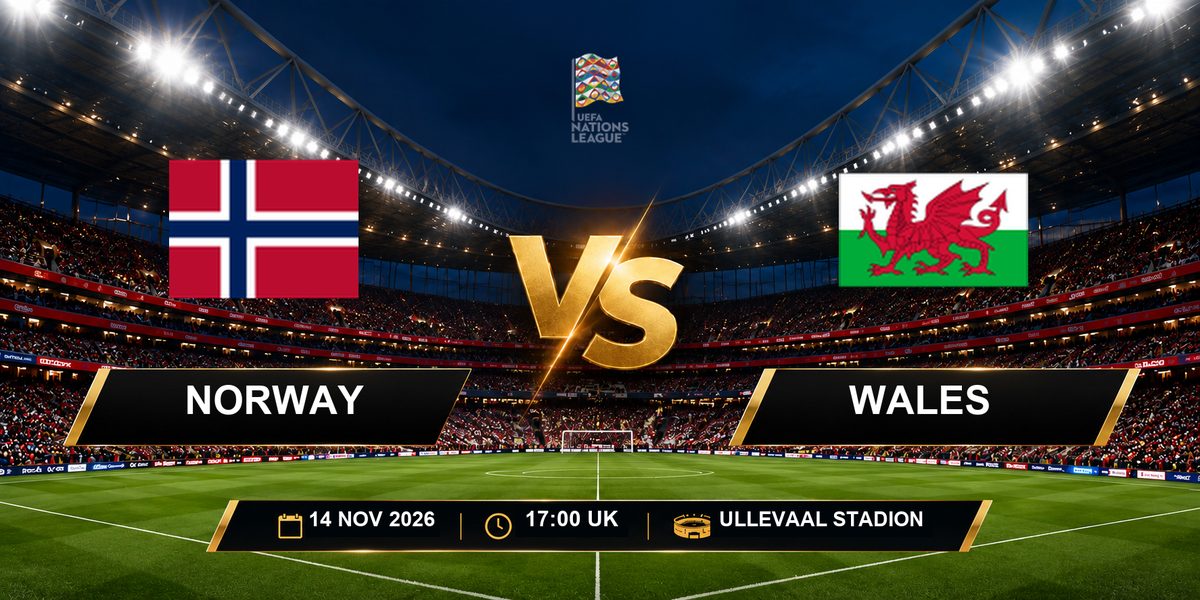

This tie is being shaped by selection dilemmas more than form: Wales arrive in Oslo without Ben Cabango (suspended) but with Joe Rodon and Harry Wilson back in the squad, while Ståle Solbakken has signalled rotation across the November double‑header and left his goalkeeper choice open. That makes Bellamy’s back‑line decisions and Solbakken’s willingness to rest players the clearest tactical subplots ahead of kick‑off at Ullevaal Stadion, 17:00 GMT on Saturday. Heavy snow in Oslo on Thursday complicated Norway’s outdoor preparation, adding a weather variable to a fixture that carries immediate Nations League consequences for both nations. The match should reward whoever adapts fastest to personnel changes and a potentially tricky pitch.
Norway
Solbakken’s squad list and public media programme make his thinking visible: the coach has recalled Alexander Sørloth, Eivind Helland and Felix Horn Myhre and kept the goalkeeper role undecided, while UEFA’s squad page confirms the availability of the usual attacking spine — Erling Haaland, Martin Ødegaard and Antonio Nusa. Those names mean Solbakken will still have high‑end finishing and creative options even if he rotates elsewhere; the recalled forwards give him the capacity to refresh the attack without a drastic drop in threat. The NFF’s scheduled press windows also suggest Solbakken plans to communicate a measured, rotation‑focused approach rather than gamble everything on a single XI.
The late weather interruption at Ullevaal is more than inconvenience. Thursday’s heavy snow forced the team indoors and limited pitch work, so Solbakken’s staff will need to decide whether to retain their preferred passing patterns or simplify the game plan to suit a potentially soft or sticky surface. The open goalkeeper question increases the stakes: a less experienced keeper or a rotated defensive unit could make Norway more vulnerable to set pieces and direct play, especially if the pitch reduces precision from the back. Solbakken’s usual flexibility therefore becomes a double‑edged sword — freshness against the risk of disrupted cohesion.
Facing Wales, Norway’s challenge is to convert their attacking riches into a clean result while plugging defensive leaks. The group displays a tendency for high‑variance scorelines — Norway can hit multiple goals but has also conceded heavily — so the front three are critical in forcing Wales out of their defensive shape. The presence of Sørloth and Schjelderup behind Haaland offers varied finishing channels, and if Solbakken resists wholesale rest for his core attackers, Norway’s home forward line should be capable of exploiting any hastily assembled Welsh centre‑back pairing.
 Advertisement
Wales
Craig Bellamy’s squad announcement on 4 November underlined his immediate headache: Ben Cabango is suspended for this fixture while Jordan James remains injured, but Joe Rodon, Harry Wilson and Karl Darlow return to the group. Bellamy has publicly framed the double‑header as an attacking opportunity while stressing rotation across two matches; that balancing act matters here because the available defensive resources have shifted. The FAW’s communication is decisive on Cabango’s absence, while a separate live service listing Sorba Thomas as suspended remains unconfirmed and cannot be treated as official at present.
Practically, Cabango’s suspension forces Bellamy to rebuild centrally. Rodon’s return is the most significant single bit of personnel news — his presence restores top‑level minutes and aerial competence at centre‑back — but he may need a new partner in the short term, which alters Wales’ approach to defending Haaland and Norway’s tall forwards. Wilson’s inclusion broadens creative outlets in midfield and on the left, which could let Bellamy offset defensive reshaping by asking Wales to be more proactive in transition and set‑piece situations. Bellamy’s declared management of minutes across two fixtures increases the likelihood of measured selection rather than wholesale risk‑taking in Oslo.
The opponent presents a particular test: Wales beat Norway 2–1 in Cardiff in early October, so Bellamy knows his side can win this matchup, but that result came with a different availability map and at home. Against Norway’s front line, Wales must protect Rosenthal-sized gaps that appear when Cabango is absent; aerial contests and second‑ball battles will be decisive. If the snow affects Ullevaal and reduces Norway’s technical rhythm, that could favour Wales’ more direct phases and make Rodon’s experience even more pivotal. Conversely, any uncertainty in Wales’ back line will be ruthlessly exposed by Haaland and the supporting runners.
Verdict
This fixture pivots on personnel management and short‑term adaptation. Norway possess superior individual firepower and can field Haaland and Ødegaard even under a rotation policy, while the snow disruption raises questions over how fluid their build‑up will be; Solbakken must balance freshness with cohesion. Wales’ reinstatements — notably Joe Rodon — partially mitigate the blow of Ben Cabango’s suspension, but Bellamy’s forced reconfiguration of the centre‑backs is untimely against a home side with varied attacking options. Given Norway’s home resources and Wales’ defensive reshuffle, the balance favours the hosts if Solbakken resists excessive tinkering. Our prediction: Norway to win
Tip
Both teams to score — yes. Wales have shown they can score against Norway and are unlikely to shut out a Norwegian attack that includes Haaland and several recognised finishers, while Norway’s recent results show they concede as often as they score; the evidence supports expecting goals at both ends rather than a goalless affair.