
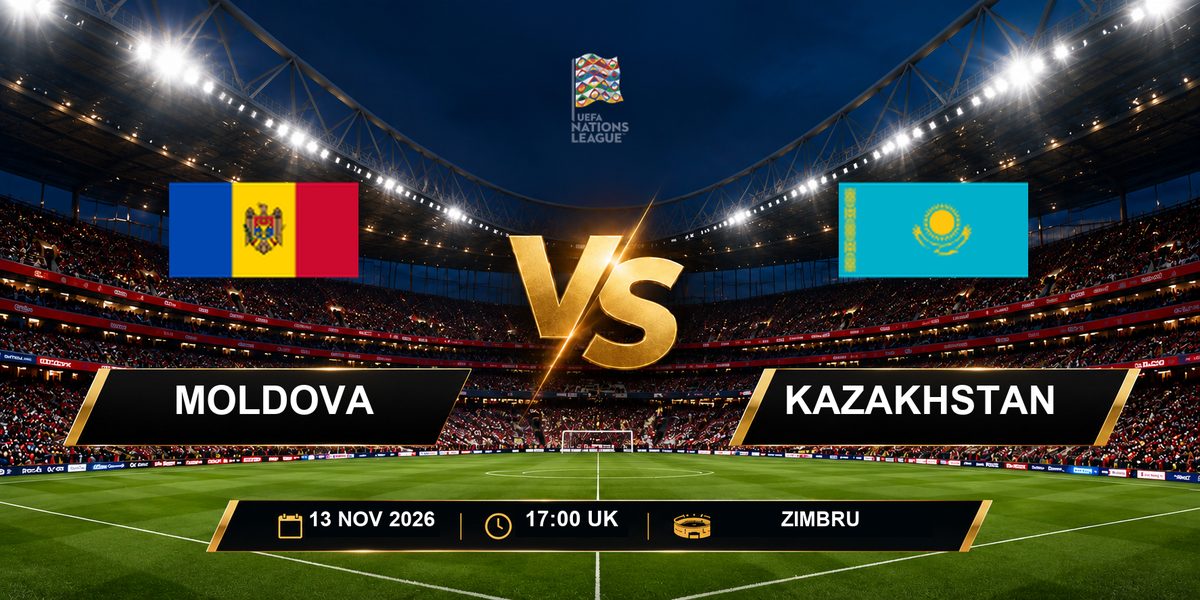


Moldova return to Zimbru on Friday, 13 November (kick-off 17:00 GMT) to face Kazakhstan in a Nations League meeting that carries more than group points for both coaches. Lilian Popescu’s side arrive having already beaten Kazakhstan away in early October, and Popescu has given clear media access on the eve of the game, underlining his intent to control the narrative. For Kazakhstan, John van ’t Schip brings a squad announced at the end of October and faces selection headaches after reported late absences and disciplinary uncertainty. The short turnaround to both nations’ second fixtures on 16 November invests this match with selection significance as much as immediate consequence.
Moldova
FMF published a full press schedule for the eve of the game and confirmed that Lilian Popescu and goalkeeper Dumitru Celeadnic would address the media, while the squad list made public earlier this month excludes Ion Nicolaescu through injury and omits Vitalie Damașcan. That official footing matters: Celeadnic’s inclusion in the media window is a reminder that Popescu sees his goalkeeper as a key figure, and the arrival of young Alexandru Bețivu — called up for the first time — gives Popescu an extra attacking option without changing the defensive spine. The federation’s openness also signals a settled camp and a manager prepared to make public explanations for selection choices.
Popescu has employed a back-five base across this international window, and recent match evidence shows Moldova can turn that structure into a platform for direct threats from two forwards. With Nicolaescu absent, Popescu must reassign finishing duties; the squad’s available forwards and the first call for Bețivu suggest he will prioritise a compact defensive shape and quick transitions rather than expansive possession. That shape tends to suppress space between the lines, which will influence Kazakhstan’s approach and magnify the importance of set-plays and second balls inside Zimbru.
Facing Kazakhstan’s specific profile, Moldova have the psychological and tactical advantage of a recent away success in their favour. The 2–1 victory in Astana earlier this window gives Popescu a concrete blueprint for upsetting van ’t Schip’s side again: maintain defensive rigidity, force Kazakhstan to work for chances and strike from moments of transition. Popescu’s decisions over which forwards to start and how much to risk pushing wing-backs forward will be decisive; the manager can afford to favour defensive continuity at home while allowing a counter threat from the bench late on.
 Advertisement
Kazakhstan
The Kazakhstan Football Federation published the November squad on 28 October, providing John van ’t Schip with a 27‑player pool and a clear schedule for the window. Subsequent reporting has suggested a significant blow to their forward options: FC Astana striker Ramazan Karimov was reportedly ruled out and Aibar Zhaksylykov called up as cover. Van ’t Schip’s public preparations included a press session and official training access in Chișinău, indicating he has had the usual media and on-site work to plan selection despite the disruption. Those formal arrangements contrast with the uncertainty around attacking personnel.
If Karimov’s absence is confirmed, Kazakhstan’s attacking emphasis will shift. Karimov’s contributions in the group had been part of Kazakhstan’s route to goals and his loss obliges van ’t Schip to rely more on creativity from midfield and set-piece situations. That change narrows the profile of runs into the box and increases the value of players who can beat a back five from deeper positions. How van ’t Schip adapts his front-line — whether by pushing a midfielder into a more advanced role or by selecting Zhaksylykov as an uncomfortable but necessary alternative — will determine how much sustained pressure Kazakhstan can exert at Zimbru.
Discipline and squad depth add another layer of concern for Kazakhstan. Match reports from the 6 October draw with the Faroe Islands recorded a red card for Sergei Maly, and preview coverage has inferred that this could carry at least a one-match suspension. If that absence is enforced, van ’t Schip may have to reshuffle experienced defensive options; paired with a weakened attack, it presents a selection puzzle. With both sides having fixtures on 16 November, Kazakhstan must weigh the short-term need for a result here against the risk of overextending players for the next game.
Verdict
The strongest threads running through the pre-match reporting favour Moldova. Popescu has built a reliable defensive base and has evidence his approach can stifle Kazakhstan, as shown in the 2–1 win in Astana; that result gives Moldova an actionable template to repeat at Zimbru. Kazakhstan arrive with their forward options clouded by the reported Karimov withdrawal and the potential loss of Sergei Maly to suspension, which together sap attacking threat and experienced defensive cover. The short turnaround to subsequent fixtures increases the likelihood both managers will prioritise control and cautious selection rather than open attacking gambles. On balance, the combination of home organisation, Moldova’s recent head‑to‑head success and Kazakhstan’s personnel doubts point towards a narrow home victory. Our prediction: Moldova to win
Tip
Tip: Back Moldova to win. The recommendation rests on Moldova’s confirmed tactical continuity under Lilian Popescu, their prior 2–1 victory in Astana this window and Kazakhstan’s reported loss of a key striker alongside possible defensive suspension, factors that reduce the visitors’ upside and favour a Moldova result at Zimbru.