

| 1X2 | Home | Draw | Away | |
|---|---|---|---|---|
|
Coolbet
|
1.06 | 16.00 | 35.00 | Go to Coolbet → |
|
ComeOn
|
1.07 | 12.75 | 23.00 | Go to ComeOn → |
|
Unibet
|
1.08 | 11.50 | 21.00 | Go to Unibet → |
|
Norsk Tipping
|
1.07 | 11.50 | 20.00 | Go to Norsk Tipping → |
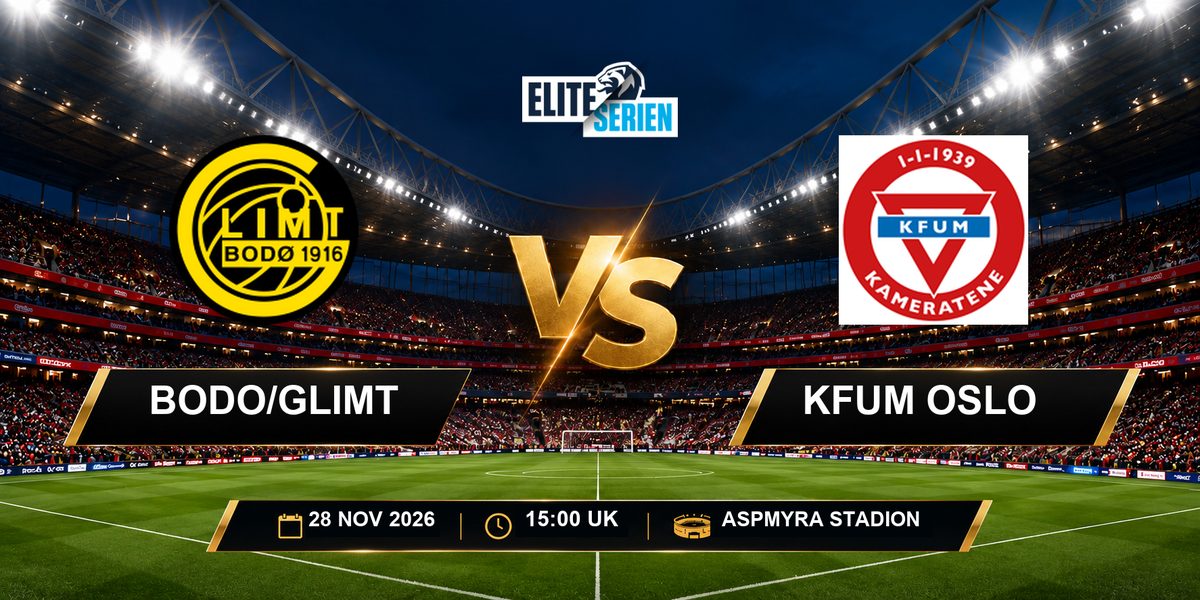
Bodø/Glimt return to Aspmyra on Saturday with a midwinter league fixture against KFUM Oslo that carries more than routine three points; the home side are balancing domestic title ambitions with late‑November European commitments. Knutsen’s squad arrive off a Champions League win on 24 November, an encouraging result that also creates tight turnaround and selection questions. KFUM come north as a mid‑table side that have shown they can score but have also left themselves exposed defensively in recent weeks. This clash will be decided as much by recovery and rotation choices as by what either manager asks of his wide players.
Bodo/Glimt
Bodø/Glimt confirmed Aspmyra as the venue and Kjetil Knutsen explicitly appealed for fan backing, underlining how the club values a strong home atmosphere for this late‑season stretch. That appeal arrived after a 1–0 win over LASK in the Champions League on 24 November, a competitive outing that compresses recovery time for core starters. The club has also announced a partnership to centralise medical and physical data, a practical tool Knutsen can use to shape rotation in the short term; the new insitu.fit pipeline suggests selection will be informed by monitored load metrics rather than guesswork alone. Those developments make the managerial call on who rests a technical decision backed by fresh resources.
Recent match reports list Håkon Evjen (knee) and August Mikkelsen (groin) among players unavailable in the immediate cycle, which leaves Glimt short in the creative wide positions that usually supply their transitions. That reported absence forces Knutsen either to promote bench options who have played less European minutes or to reassign other attackers to the flanks; the club’s medical data programme should reduce risk when adjusting minutes, but there is nonetheless a drop in proven personnel on the wings. How Knutsen manages the balance between preserving key starters for domestic fixtures and avoiding a loss of cutting edge will be decisive against an opponent that tests width.
Facing KFUM’s likely wing‑forward structure, Glimt must ensure their rotation choices do not blunt forward momentum. The Champions League rhythm this week may require a different match tempo at Aspmyra, and Knutsen’s public plea for supporters indicates he expects atmosphere to help compensate for any rotation‑induced drop in spark. Historical meetings show Glimt have handled KFUM before this season, but the immediate tactical puzzle is whether rotated wide options can still press and sprint effectively enough to exploit KFUM’s wing areas over 90 minutes.
 Advertisement
KFUM Oslo
KFUM’s recent home fixture against Brann left the squad with a pair of post‑match availability concerns: Ayoub Aleesami is reported with a groin issue and Fredrik Tobias Berglie has been listed unavailable in the same cycle. Those setbacks matter because recent match coverage presents KFUM operating in a 3‑4‑3 or wing‑forward system, roles in which Aleesami and Berglie play key parts defensively and in transition. Losing either disrupts the balance between providing width and covering the channels against a side known for quick transitions, and it forces a reshuffle of roles that have been established in recent fixtures.
The club’s off‑field incident — a floodlight failure at KFUM Arena that prompted public apologies and compensation measures — is an operational distraction rather than a footballing one, but it does create a short window of logistical noise and strained supporter relations. That background may not affect performance directly, yet it places an additional burden on the coaching staff to keep focus ahead of a tough away trip. On the pitch, KFUM’s 3–4–4‑type attacking intent in some results has produced goals but also defensive lapses; the squad will need to shore up the back three if they are to blunt Glimt’s runners.
KFUM travel having shown they can score against stronger opposition, but their defensive record leaves them vulnerable to teams that play at pace and exploit wide overloads. With Glimt likely to rotate but still possess high‑quality transitional threats, KFUM’s challenge is twofold: cover the wide corridors in the absence of first‑choice wing‑defenders, and prevent bodies from being pulled out of position by Glimt’s runners. Their mid‑table standing means they can play without the immediate pressure of relegation, but it also makes this match a test of whether they can upset the league leaders away from home.
Verdict
This fixture shapes up as a battle between Bodø/Glimt’s squad resourcefulness and KFUM’s ability to plug holes on the flanks. Glimt’s win in the Champions League on 24 November complicates selection but the club’s investment in centralised medical data points to smarter short‑term rotation rather than wholesale weakening; Knutsen’s public call for fans indicates he expects the crowd to help carry rotated players through any early lull. KFUM arrive with tangible absences among their wing‑defensive group and recent matches show a tendency to concede when stretched laterally. Given the home side’s superior depth, the medical infrastructure to manage load, and the likelihood that Glimt will field enough quality to dominate wide exchanges, Bodø/Glimt look best placed to take the points. Our prediction: Bodo/Glimt to win
Tip
Tip: Back Bodo/Glimt to win. The home side combine recent European momentum with a new centralised medical system that should allow Knutsen to rotate intelligently without losing overall intensity, while KFUM face reported absences to key wide defenders and the logistical distraction of the club’s recent floodlight incident. Those factors point to Glimt retaining their edge at Aspmyra.