

| 1X2 | Home | Draw | Away | |
|---|---|---|---|---|
|
Coolbet
|
2.46 | 3.20 | 3.14 | Go to Coolbet → |
|
Epicbet
|
2.43 | 3.17 | 3.09 | Go to Epicbet → |
|
Casino Friday
|
2.36 | 3.14 | 3.14 | Go to Casino Friday → |
|
UnionBet
|
2.36 | 3.14 | 3.14 | Go to UnionBet → |
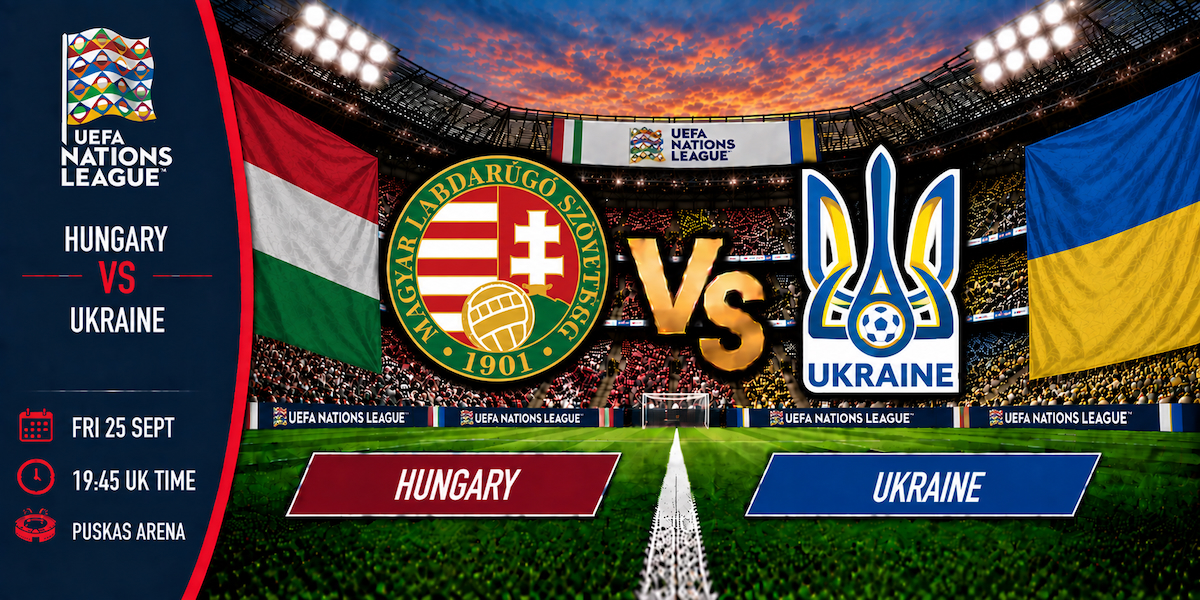
Hungary and Ukraine begin their 2026-27 UEFA Nations League campaigns at the Puskás Aréna on Friday evening, with both attempting to turn recent disappointment into a fresh start.
Marco Rossi’s Hungary return to League B following relegation from the top tier, while Ukraine begin their first competitive campaign under Italian coach Andrea Maldera. Georgia and Northern Ireland complete Group B2, leaving two sides with realistic promotion ambitions little room for a slow start.
The circumstances are not ideal for either manager. Hungary have lost two of their most important attackers to injury, while Ukraine have made significant changes to their match-day squad ahead of Maldera’s competitive debut.
Hungary rebuild after World Cup disappointment
Few results in Rossi’s long spell as Hungary manager will have hurt quite like the defeat to the Republic of Ireland that ended their World Cup hopes.
Hungary had entered the final round of qualifying in position to reach the playoffs, only for Troy Parrott’s dramatic late winner in Budapest to turn the group on its head.
Missing another World Cup was particularly frustrating because Hungary had established themselves as a difficult opponent for Europe’s leading nations. They reached three consecutive European Championships, competed in League A of the Nations League and produced notable results against Germany, England and Portugal during Rossi’s tenure.
The immediate response to their World Cup disappointment has at least been encouraging. Hungary are unbeaten in four matches in 2026, recording friendly victories over Slovenia, Finland and Kazakhstan alongside a goalless draw with Greece. Their broader record is also respectable, with only one defeat in their last eight matches across all competitions.
Dropping into League B therefore provides an opportunity rather than simply representing punishment for relegation. Hungary will believe they are capable of challenging for promotion in a group containing Ukraine, Georgia and Northern Ireland, and taking maximum points from their opening home fixture would immediately reinforce that ambition.
Rossi must do so without two major attacking weapons. Barnabás Varga and Roland Sallai are both unavailable through injury, while Callum Styles has also withdrawn from the squad. Rossi acknowledged before the match that replacing Varga and Sallai may require tactical changes, particularly because Hungary do not have obvious like-for-like alternatives.
Varga’s absence removes Hungary’s main aerial presence and conventional centre-forward, while Sallai’s direct running and versatility will also be missed.
Dániel Lukács is one candidate to operate through the middle, while Damir Redzic could be given an opportunity from the right. Liverpool midfielder Dominik Szoboszlai may consequently take up a more advanced role from the left, although his freedom to move centrally remains fundamental to Hungary’s attacking game.
Szoboszlai is now unquestionably the team’s central figure. His set-piece delivery, long-range shooting and ability to accelerate attacks give Hungary something different in a side that can otherwise struggle to break down compact opponents.
Rossi has also used this international window to introduce new blood. Five uncapped players were included in the original 26-man squad, with changes across virtually every area of the team as Hungary begin looking towards Euro 2028.
There is still a familiar defensive core, though. Willi Orbán provides experience at centre-back, Milos Kerkez offers an attacking outlet from the left and András Schäfer should play an important role in midfield.
The challenge will be finding the right balance between that established structure and an attack missing two automatic selections.
 Advertisement
Maldera begins competitive life with Ukraine
Ukraine arrive in Budapest facing a transition of their own. Their previous Nations League campaign ended in frustration when Belgium beat them 4-3 on aggregate in the promotion playoff, leaving Ukraine in League B despite coming close to joining Europe’s top tier.
The disappointment continued during the World Cup cycle, and Andrea Maldera was appointed in May as the first foreign head coach in the history of Ukraine’s national team. His opening two matches offered contrasting results but some encouragement.
Ukraine began the Italian’s reign with a 2-0 victory in Poland before losing 2-1 to Denmark. Friday therefore represents Maldera’s first opportunity to see his methods tested in competitive football.
The coach originally selected an expanded 30-man squad for this international period, including several new faces, as he begins reshaping the team.
There have since been important changes. Artem Dovbyk is unavailable through injury, while Ruslan Malinovskyi is another notable absentee. Most significantly for Friday’s match, Yaremchuk and Shaparenko have not made Ukraine’s final 23-man squad against Hungary. Suspended midfielder Ivan Varfolomeyev is also unavailable.
That leaves Maldera with decisions to make throughout his attacking structure. Georgiy Sudakov remains one of Ukraine’s most important creative players and should be given considerable responsibility between midfield and attack. Viktor Tsygankov offers another threat from wider areas, while Oleksandr Zubkov and Vladyslav Vanat are among the options available further forward.
At the opposite end, Illia Zabarnyi remains central to Ukraine’s plans. The Paris Saint-Germain defender was deployed at right-back against Denmark, demonstrating the tactical flexibility Maldera appears willing to explore.
Ukraine’s problem in recent matches has generally been less about individual talent than turning promising possession into enough goals. They have gone seven games without scoring more than twice in a single match, and the absence of several experienced attacking options does little to simplify matters.
The Puskás Aréna is also a demanding venue for Maldera’s competitive debut. All four of Hungary’s 2026 friendlies were played at home, where they beat Slovenia, Finland and Kazakhstan and drew with Greece.
This will also be a rare meeting between the nations. Their only previous encounter came in 1992, making Friday’s fixture their first in more than three decades.
Verdict
Neither side arrives with its preferred attacking lineup, which could make this a more cautious contest than the individual talent suggests.
Ukraine have enough technical quality through players such as Sudakov and Tsygankov to cause Hungary problems, while Maldera’s first two matches indicated that he wants his team to play positively rather than simply protect themselves away from home.
Hungary, however, have become difficult to beat again since their World Cup disappointment. Three victories and a draw from their four matches this year have restored some confidence, and the Puskás Aréna remains an important advantage.
Varga and Sallai are significant losses, so Hungary may have to find a different route to goal. Szoboszlai’s influence could consequently become even more important, particularly from set pieces and in the closing stages if the match remains tight.
There is little to separate the teams, but Hungary’s recent home form gives them a plausible route to starting their League B campaign with three points.
Tip: Hungary to win