
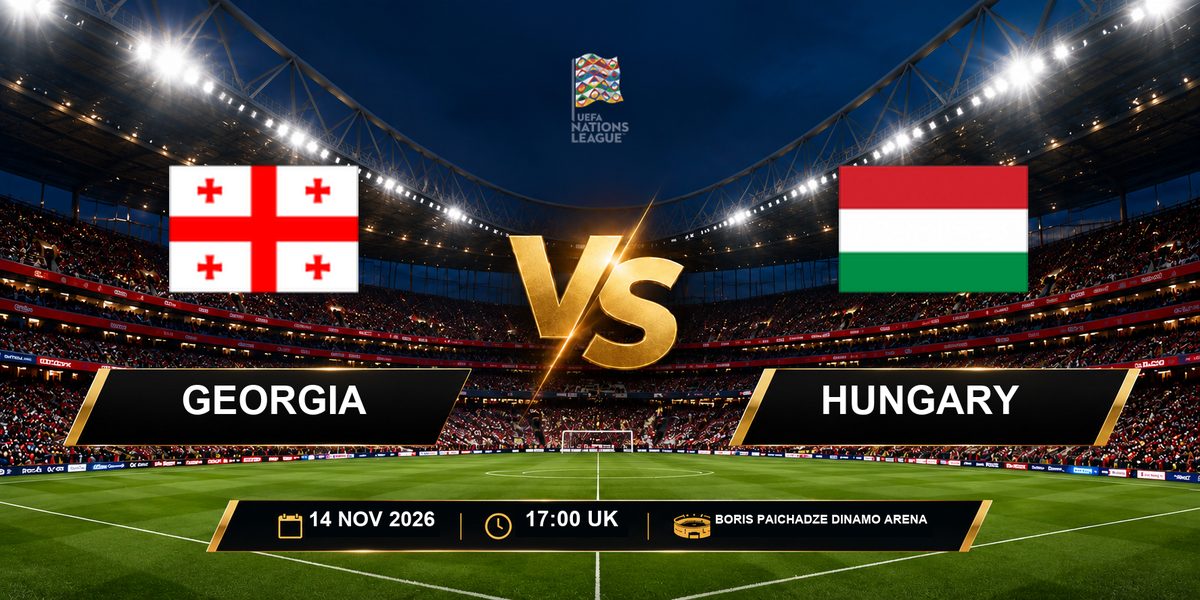


Dominik Szoboszlai’s availability has become the match’s overriding storyline: Hungary’s captain reported to camp but failed an early fitness test and the federation says his involvement will be decided at the last minute. The game at the Boris Paichadze Dinamo Arena kicks off at 17:00 GMT on Saturday and carries real consequences for both sides as this Nations League window closes. Georgia arrive under Ramaz Svanadze, the former Under‑21 coach who was promoted in September and has had a curtailed preparation after two players missed training with a virus. Hungary’s delegation, meanwhile, has also had personnel movement and the federation has warned supporters about away‑ticket restrictions for Tbilisi.
Georgia
Ramaz Svanadze’s appointment is the clearest single development in Tbilisi. Official updates show the new coach has been working with a 26‑player group and has taken the chance to blood three debutants, while senior figures such as Budu Zivzivadze have publicly framed the week as an opportunity to absorb the new coach’s ideas. That background matters because Svanadze is still assembling a clear identity and must balance integrating newcomers with the immediate need for results in a compact international schedule.
The squad interruptions noted by the Georgian FA — Sandro Altunashvili and Giorgi Mikautadze missing training due to a virus — change selection options in a practical way. With two forwards or attacking midfielders absent from sessions, Svanadze’s options for an attacking frontline are narrower and the coach may either accelerate the promotion of the debutants or ask his more experienced players to shoulder greater responsibility. That selection squeeze will shape how Georgia approach match moments that demand cutting precision in the final third.
Against Hungary the concrete challenge for Georgia is managing set‑piece and aerial contests while creating clear chances of their own. Tbilisi will be the place to deploy home familiarity, but the combination of a coach in transition and recent training absences means Georgia’s staff must decide whether to protect a fragile defensive shape or chase the breakthrough with less‑proven attacking personnel. How Svanadze configures his matchday squad will determine whether Georgia can threaten Hungary in the areas where the visitors are weakest.
 Advertisement
Hungary
Marco Rossi’s squad for November blends returning senior pros with fresh call‑ups; the federation publicly listed names such as Attila Szalai, Roland Sallai and Barnabás Varga alongside newcomers Milán Pető, Ákos Szendrei and József Urblík. There has been forced change too: Szűcs Kornél was summoned as cover for the injured Várkonyi Bence, and Szoboszlai’s late fitness uncertainty hangs over the group. The federation’s public messaging has set expectations clearly — the captain’s status is a live decision — which shapes both headline narratives and what Rossi can select for his match plan.
Szoboszlai’s conditional involvement is the practical football question. If he is cleared to play, Hungary retain the option of using their most influential midfielder to create moments in tight games; if he is absent, the burden falls to the returning Sallai and Varga and the manager’s rotation options. That last‑minute fitness call does not just affect a single role on the pitch: it forces Rossi to think about balance, game management and how to extract creativity from players who have had varying levels of club action through the season.
Off the pitch there is also a regulatory complication that could affect how Hungary approach the match. MLSZ’s public confirmation that away tickets cannot be sold in the usual sections for this game, and the explicit warning to supporters not to buy tickets in home‑supporter areas, reduces the travelling contingent and changes the matchday complexion. Practically, that means Hungary must prepare to secure a result without relying on a vocal away presence; in footballing terms, it emphasises the need for calm, controlled performance from the squad regardless of who is available on the left side of the pitch or the bench.
Verdict
This fixture tilts in Hungary’s favour on personnel and recent head‑to‑head evidence: Rossi has more experienced international options available and has already prevailed over Georgia earlier in the cycle. Szoboszlai’s situation is pivotal — his presence would increase Hungary’s ability to fashion the decisive moments, while his absence hands greater importance to Sallai and Varga and to Rossi’s bench decisions. Georgia’s new manager has shown intent in his selections, but the short lead‑in and recent training absences reduce the likelihood of a rapid attacking turnaround. On balance, Hungary look the likelier winners in Tbilisi because of deeper experience and a clearer set of senior options; our prediction: Hungary to win.
Tip
Tip: Back Hungary to win. The visitors arrive with a cohesive core of experienced internationals and a recent success over Georgia in this Nations League campaign, while Szoboszlai’s last‑minute fitness call creates a binary outcome—either he boosts an already strong group or Hungary fall back on reliable senior figures capable of delivering a positive result.