
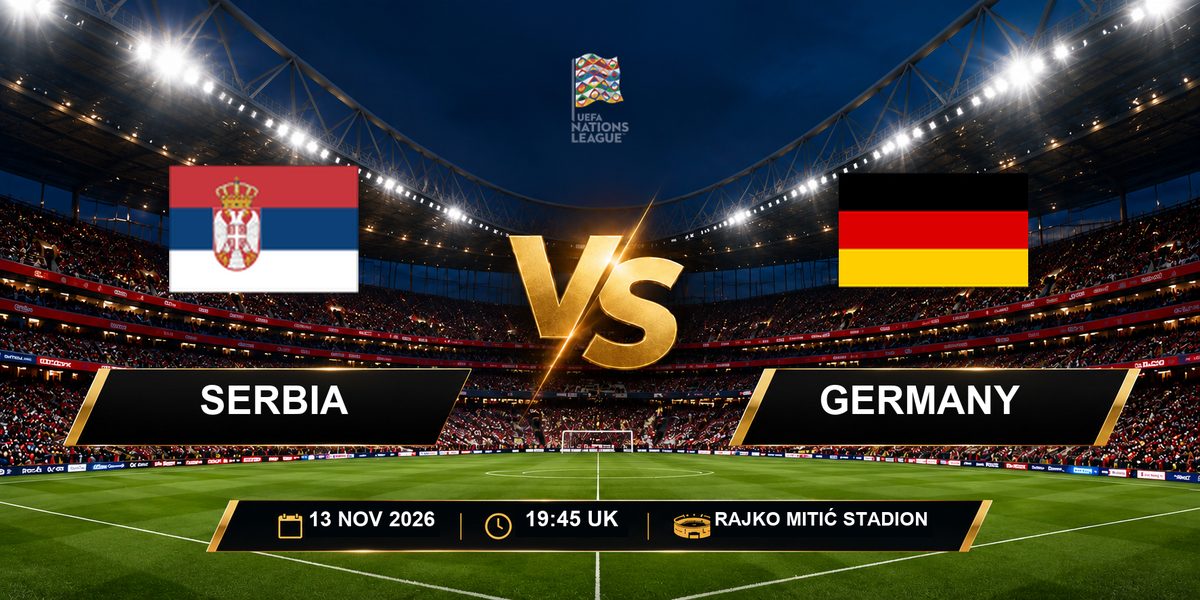

Serbia’s acute midfield crisis — two suspensions and fresh injuries to senior personnel — is the defining issue as Veljko Paunović prepares for Germany’s visit to the Rajko Mitić Stadion on Friday, kick‑off 19:45 GMT. Jürgen Klopp arrives with selection amendments of his own: Waldemar Anton replaced by Ridle Baku and the recall of Niclas Füllkrug have reshaped Germany’s forward and defensive options. The closed‑door nature of the match under UEFA sanction removes some home‑pitch variables, sharpening the focus on personnel battles in central areas. How Paunović rebuilds the pivot against a German side explicitly asking its striker and wide players to press and get forward will decide the night.
Serbia
Paunović entered the Belgrade press conference acknowledging the scale of his selection headache: Nemanja Maksimović and Saša Lukić are suspended, Aleksandar Stanković and Filip Kostić have been ruled out with injury, Strahinja Pavlović is unlikely to feature after a medical issue, and Dušan Vlahović has not joined the camp for personal reasons. The coach has emphasised load management and adapting to multiple absences, and he has already drafted in Miljan Krpić as a late defensive addition. Those named changes are concrete and they force a small, experienced group to cover more roles across two matches in quick succession.
The immediate football consequence is a reshuffle of the central spine. Losing both first‑choice central midfielders and Stanković removes Paunović’s primary options for controlling midfield exchanges and managing transitional moments. He has talked about matching Germany’s intensity despite these limits, which suggests a pragmatic approach: tighter defensive spacing, careful rotation during the game and reliance on players who can win second balls and protect the back line. That will also influence how Paunović picks his forward line, given Vlahović’s absence removes a regular focal point and potentially shifts responsibility onto younger or less proven attacking options.
Facing Germany, Serbia’s selection problems translate into tactical vulnerability. Klopp’s notes and his players’ public comments make clear Germany will ask their striker to be the first line of defence and expect full‑backs or wide recruits to push on; that combination targets the very part of the pitch Serbia can no longer staff with their strongest personnel. Paunović’s public insistence on matching intensity is meaningful, but the closed stadium neutralises crowd pressure that might otherwise galvanise makeshift midfield pairings. Serbia will need discipline from recalled or newly called players and a compact defensive plan to blunt Germany’s planned forward thrusts.
 Advertisement
Germany
Klopp’s group has seen a late alteration in defence with Waldemar Anton withdrawn and Ridle Baku drafted in, while Niclas Füllkrug’s recall has been framed by the striker himself as a duty to act as "the first line of defence." The DFB’s communications and comments from younger recruits such as Philipp Treu and Derry Scherhant indicate a deliberate blend: experienced figures supplemented by players Klopp wants to encourage to get forward. Those are confirmed selection signals rather than speculation; they outline what Klopp expects from his personnel on match day.
Practically, Füllkrug’s return gives Germany an option who will, by his own description, initiate defensive actions from the front and act as a physical presence in transitional moments. Baku’s late inclusion widens Klopp’s defensive profiles at right‑side positions and across the back line. Klopp must balance the need for points with the two‑game schedule, but the explicit language used by his players points to a side prepared to ask forwards and full‑backs to carry offensive weight, either from the start or through energetic substitutions should rotation be preferred.
Germany face a specific test in Belgrade despite being the fitter side on paper. Serbia’s coach has underlined a willingness to match intensity and to adapt around absences; even in a depleted state, Serbia’s selection includes defenders who can make matches fractious and force errors in transitions. The closed stadium reduces the usual crowd factor, which helps Germany’s less experienced call‑ups settle, but Klopp still needs to ensure his team does not underestimate the physical and organisational demands of containing a home side that will concentrate on disrupting midfield connections.
Verdict
Serbia’s week has been defined by confirmed absences at the heart of the team: two suspensions in midfield, two injuries sidelining senior players and the unexpected non‑attendance of their leading striker. Paunović’s public focus on adapting and managing player load is realistic, but those adaptations mean Serbia enter a fixture against a Germany side that has explicitly prepared forwards to defend from the front and added defensive cover in the squad. The closed‑door match reduces home advantage, increasing the importance of personnel. Given Serbia’s compromised central spine and Germany’s clear selection signals, the visitors look positioned to exploit transitional moments and secure the result. Our prediction: Germany to win
Tip
Tip: Back Germany to win. The argument rests on Serbia’s confirmed midfield suspensions and injuries removing first‑choice central options, while Germany arrive with a recalled striker who has declared an intent to lead the team’s defensive work and a late defensive replacement in Ridle Baku; those personnel factors, combined with the neutralising effect of a closed stadium, favour a German victory.